KOTA SAMARAHAN, 29 May 2026 – A total of 156 participants from Malaysia, Indonesia, Thailand and the Philippines took part in an international Global Classroom session titled “Limitation, Ethics, and the Future of AI”, organised in conjunction with the TMS4043 Artificial Intelligence course at the Faculty of Computer Science and Information Technology (FCSIT), Universiti Malaysia Sarawak (UNIMAS).
The session was organised by FCSIT Dean Prof Dr Jane Labadin and Mr Azizi Ahmadi, together with Natalia Nefedova, the organiser from the Moscow Institute of Physics and Technology (MIPT).
The guest speaker, Darya Zhuykova, an expert trainer, led the session on the responsible and ethical use of artificial intelligence.
The Global Classroom created an opportunity for students from different countries and educational backgrounds to engage with a shared global issue: how artificial intelligence should be used responsibly.
Of the 156 participants, 110 were from Indonesia, 44 from Malaysia, and one participant each from Thailand and the Philippines. Forty-four of the participants were from UNIMAS.
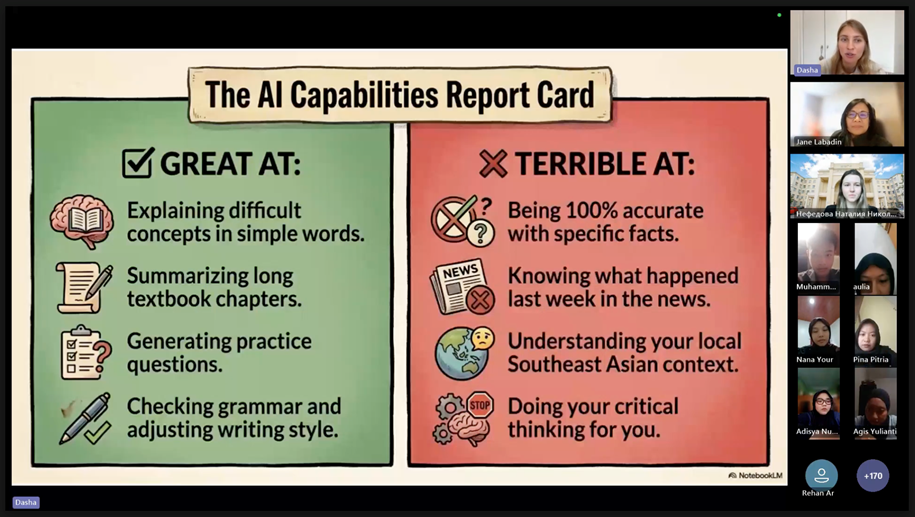
A key message from the session was that generative AI should be treated as a tool to support learning and productivity rather than as a replacement for human thinking.
Students were encouraged to use AI for brainstorming, generating quizzes and explaining difficult concepts while continuing to exercise critical judgement over the information produced.
The session also highlighted important concerns surrounding data privacy and the reliability of AI-generated information.
Participants were advised not to upload sensitive or unique research data to cloud-based AI systems and were reminded that generative AI can produce inaccurate or fabricated information.
The discussion on AI “hallucinations” reinforced the importance of verifying facts, references and links before relying on AI-generated content.
To help students make more effective use of generative AI, the speaker also introduced a practical prompt-engineering framework based on Role, Action, Context, and Example.
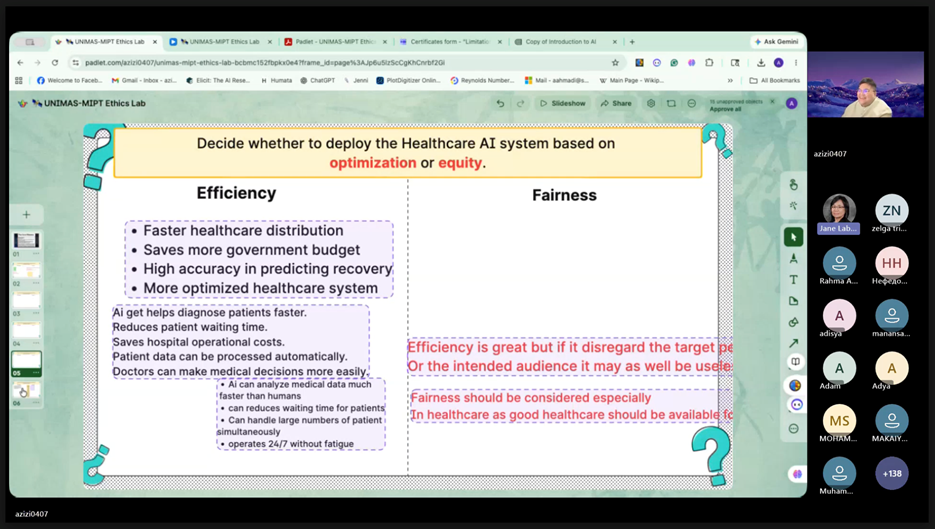
One of the highlights of the session was the interactive “AI on Trial” activity. Participants worked in breakout groups to debate whether an AI system that was 99% efficient at allocating government healthcare subsidies should be deployed, provided rural communities could be excluded due to limited digital records.
The activity encouraged students to look beyond technical efficiency and consider wider questions of fairness, inclusion and social responsibility.
Some groups highlighted the benefits of faster and more efficient subsidy allocation, while others questioned whether a highly efficient system could be considered successful if vulnerable communities were systematically left behind.
Through discussion, debate and the use of Padlet to share responses, students were encouraged to justify their views, listen to different perspectives and recognise that the most efficient technological solution may not necessarily be the most equitable.
The session demonstrated the value of the Global Classroom in connecting students across national boundaries and creating space for meaningful discussion on emerging technological issues.
In addition to strengthening AI literacy, the experience exposed students to diverse perspectives on how AI can affect individuals and communities across different social contexts.
The session concluded with an important reminder that AI should ultimately be used to improve outcomes, not merely speed them up.
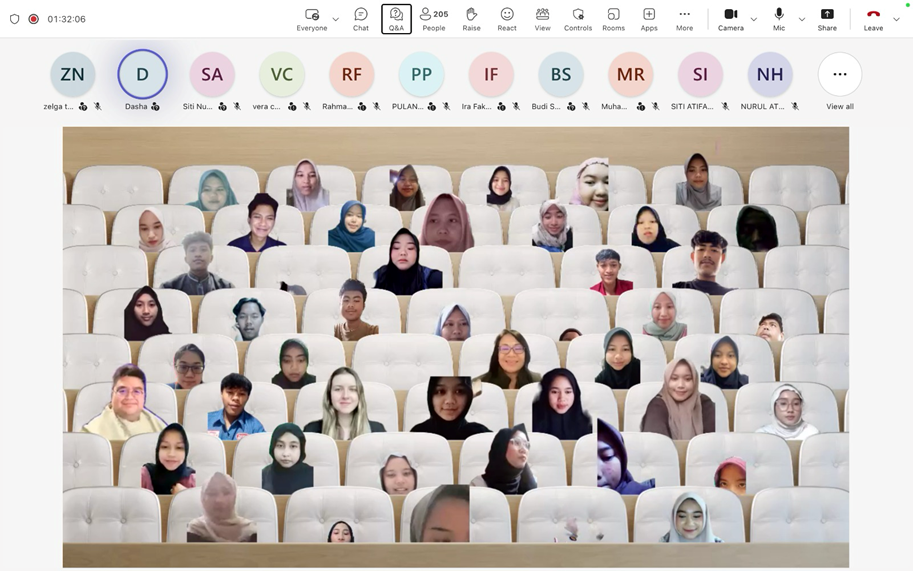
By combining expert sharing, practical AI knowledge and international student interaction, the Global Classroom strengthened students’ awareness that responsible AI requires not only technical competence, but also empathy, fairness, inclusivity and human judgement.
Written by AP Dr Sarah Flora Samson Juan
FCSIT is one of the Premier Digital Tech Institutions endorsed by Malaysia Digital Economy Corporation (MDEC).
#mypdti