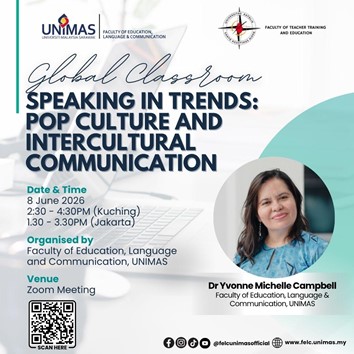
By: Melisa Malini (Senior Language Teacher)
The Faculty of Education, Language and Communication (FELC), Universiti Malaysia Sarawak (UNIMAS), in collaboration with the Faculty of Teacher Training and Education, Universitas Katolik Santos Agustinus Hippo (San Agustin), Indonesia, successfully organised the 4th Global Classroom on 8 June 2026. Held as part of an ongoing Memorandum of Understanding (MoU) and annual activity framework, the collaborative initiative reaffirms both institutions’ commitment to expanding international academic networks across the Borneo region.
The Global Classroom project serves as a strategic platform designed to enhance borderless learning, providing essential institutional benefits by fostering cross-cultural research and teaching methodologies between Malaysia and Indonesia. For students and teachers, this initiative brings people closer together despite the distance. It gives everyone a chance to gain international experience, share fresh teaching ideas, and build global communication skills without having to travel. Looking at the bigger picture, this cross-border teamwork makes quality education fairer across the region. It also shows how universities in Borneo can team up and lead meaningful conversations worldwide.
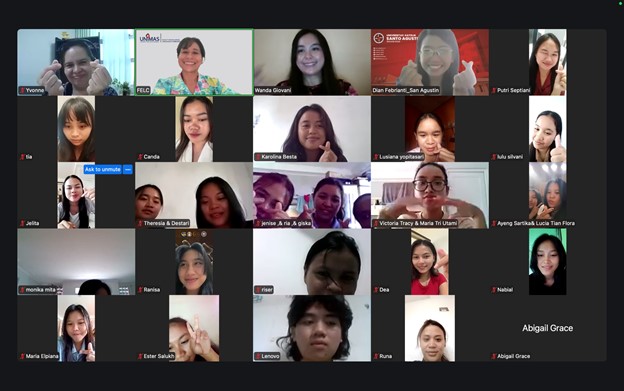
Conducted virtually via Zoom, the online session attracted almost 60 students from both UNIMAS and San Agustin, alongside two participating lecturers from the Indonesian institution. The high engagement from both student bodies highlighted the growing relevance of collaborative online international learning (COIL) frameworks in modern higher education.
The fourth instalment of the series was conducted by Dr Yvonne Michelle Campbell, the Deputy Dean of FELC and a senior lecturer teaching under the English for Global Communication programme. Delivering a lecture titled “Speaking in Trends: Pop Culture and Intercultural Communication,” Dr Campbell guided participants through an exploration of contemporary linguistic shifts and sociolinguistic phenomena.
The session proved highly engaging for both students and lecturers, sparking vibrant discussions on how modern trends reshape global discourse. The core subject matter traversed the multifaceted impacts of popular culture on language, detailing how phenomena like K-pop, internet memes, and viral media transcend geographical boundaries. Participants critically analysed the generational differences in interpreting meanings, exploring how these evolving cultural elements can either enhance global connectivity or disrupt effective cross-cultural communication due to differing contexts.
Moving forward, the session outlined strategic pathways for utilizing pop culture as a tool for inclusivity and mutual understanding.
Dr Campbell emphasised that incorporating trends into formal language and communication studies allows educators and future professionals to better navigate diverse intercultural environments, turning potential linguistic barriers into bridges for shared meaning.
The collaboration between UNIMAS and Universitas Katolik Santos Agustinus Hippo demonstrates how digital innovations can be leveraged to advance internationalisation and foster cultural harmony within the region. It is anticipated that subsequent iterations of the Global Classroom will continue to provide rich academic opportunities, empowering students to become culturally competent leaders who contribute meaningfully to a globalised society.