Review published in Oncogenesis, a Nature Portfolio journal, proposes that recurrent chromosomal rearrangements are structured biological outcomes rather than random genomic events.
Why do recurrent chromosomal rearrangements repeatedly occur at specific genomic regions rather than randomly across the genome? How do apoptosis, inflammation, viral infection, nuclear architecture, and DNA repair converge to shape genome instability during cancer development?
Although these questions have been investigated for decades, discoveries from blood cancers and solid tumours have largely progressed independently, leaving the field without a unified mechanistic explanation.
In a review article published in Oncogenesis, a Nature Portfolio peer-reviewed open access journal exploring the molecular basis of cancer and related phenomena, Dr. Tan Sang Nee (published as Sang-Nee Tan), Adjunct Senior Lecturer at the Faculty of Medicine and Health Sciences, Universiti Malaysia Sarawak (UNIMAS), brings these previously independent lines of research together into an integrative framework for cancer chromosomal rearrangements.
The article, entitled “Apoptosis-Driven Chromosomal Rearrangements in Cancer: CAD Cleavage, Nuclear Architecture, and Microhomology-Mediated End Joining,” was independently conceived and written by Dr. Tan as the sole author and corresponding author.
Rather than focusing on a single cancer type or molecular pathway, the review synthesizes discoveries accumulated over decades of research to address one of the long-standing questions in cancer biology: why recurrent chromosomal rearrangements arise at specific genomic regions. The review proposes that recurrent chromosomal rearrangements are shaped by coordinated interactions between apoptosis, nuclear architecture, and error-prone DNA repair, rather than representing purely random consequences of DNA damage. In doing so, it provides a broader conceptual framework for understanding genome instability in cancer.
A scientific story spanning more than two decades
Chromosomal rearrangements, including translocations, deletions, duplications, and inversions, are among the defining genomic alterations in cancer. They generate oncogenic fusion genes in haematological malignancies and are increasingly recognised as major drivers of genome instability in solid tumours.
Over the past two decades, studies in leukaemia have established important mechanistic insights into how apoptosis can generate chromosomal rearrangements. During apoptosis, caspase-activated DNase (CAD) cleaves chromosomal DNA, and if cells escape complete cell death through a process known as anastasis, these DNA breaks may undergo error-prone repair, giving rise to oncogenic chromosomal rearrangements.
At the same time, studies in solid tumours have revealed important roles for oxidative stress, chronic inflammation, viral infection, nuclear organisation, chromatin architecture, and DNA repair in shaping genome instability. However, these discoveries have largely been investigated within individual cancer types or biological disciplines.
Together, these discoveries provide the scientific foundation for the integrative framework presented in the review.
From random events to structured biological outcomes
Chromosomal rearrangements have traditionally been regarded as largely random consequences of DNA double-strand breaks followed by imperfect DNA repair. While this model explains how rearrangements can occur, it does not fully explain why recurrent breakpoints repeatedly arise at particular genomic regions across different patients and cancer types.
Central to the article is a conceptual framework explaining how apoptosis, nuclear architecture, chromatin organisation, and error-prone DNA repair may act together to generate recurrent chromosomal rearrangements.
Building upon mechanistic discoveries established in leukaemia together with primary research evidence from nasopharyngeal carcinoma (NPC), the article integrates findings from apoptosis, matrix attachment regions/scaffold attachment regions (MAR/SARs), nuclear architecture, DNA repair, inflammation, and viral oncogenesis into a conceptual framework.
It proposes that oxidative stress, chronic inflammation, or viral infection can initiate apoptosis, during which CAD preferentially generates DNA double-strand breaks near MAR/SARs. If some cells subsequently survive through anastasis, these DNA breaks may be repaired predominantly through microhomology-mediated end joining (MMEJ) and related error-prone end-joining pathways, producing recurrent chromosomal rearrangements that contribute to tumour initiation, clonal evolution, and cancer progression.
Rather than representing isolated mechanisms, these interconnected processes may reflect a common biological principle underlying recurrent chromosomal rearrangements across diverse cancer types.
The review further examines the potential applicability of this framework to a broader spectrum of virus- and inflammation-associated malignancies, including hepatocellular carcinoma, cervical cancer, oesophageal cancer, EBV-associated lymphoma, bladder cancer, ulcerative colitis-associated colorectal cancer, and gastric cancer, while outlining future studies needed to validate and refine the proposed model.
Rethinking the role of cell death in cancer
Apoptosis has traditionally been viewed as a protective mechanism that eliminates damaged cells and suppresses tumour development.
The review also offers a more nuanced perspective on apoptosis: under conditions of chronic inflammation, oxidative stress, or viral infection, apoptosis may also contribute to shaping the cancer genome if a subset of cells survives incomplete cell death. In these surviving cells, apoptosis-induced DNA breaks may become substrates for error-prone DNA repair, generating chromosomal rearrangements that promote tumour evolution.
Rather than serving solely as the endpoint of cell death, apoptosis may therefore represent an important biological process capable of reshaping genome architecture under specific pathological conditions.
Scientific significance and future perspectives
By placing apoptosis, nuclear architecture, chromosomal breakpoint biology, inflammation, viral oncogenesis, and DNA repair within a common biological framework, the review offers a more integrated understanding of how genome instability may arise during cancer development.
Beyond advancing this conceptual framework, the article discusses how emerging technologies, including whole-genome sequencing, single-cell genomics, spatial genomics, and liquid biopsy, may facilitate the identification of apoptotic DNA molecular footprints and structured chromosomal rearrangement signatures as biomarkers of genome instability and chromosomal rearrangement hotspots.
The review also explores DNA polymerase theta (Polθ) and the MMEJ pathway as potential therapeutic targets for limiting genome instability in cancer, highlighting opportunities for future clinical research and precision oncology.
Because chromosomal rearrangements can simultaneously influence oncogene activation, clonal evolution, and genome instability, the proposed framework may also provide new perspectives on how these genomic alterations contribute to immune evasion and therapeutic resistance during cancer progression.
More broadly, the review provides a conceptual foundation for future investigations into the interplay between cell death, genome instability, cancer evolution, and anti-tumour immunity.
Dr. Tan Sang Nee (published as Sang-Nee Tan) is an Adjunct Senior Lecturer at the Faculty of Medicine and Health Sciences, Universiti Malaysia Sarawak (UNIMAS). Her research spans tumour immunology, cancer biology, cell death, DNA damage and repair, and genome instability. With expertise across these fields, she also continues to contribute to the international scientific community as an ad hoc peer reviewer for Cell Death Discovery, a Nature Portfolio journal, evaluating manuscripts in these and related areas.
Building upon a series of first-author primary research articles arising from Dr. Tan’s research conducted at the Faculty of Medicine and Health Sciences, UNIMAS, under the supervision of Professor Sim Sai Peng, the review was further developed through her subsequent research and broader interdisciplinary research experience. It integrates complementary discoveries from the same research group together with broader international studies spanning more than two decades. This highlights how foundational research carried out at UNIMAS contributed to the development of the broader conceptual framework presented in the review.
Overall, the review provides an integrative conceptual framework for understanding how apoptosis, nuclear architecture, and DNA repair cooperate to shape genome instability in cancer. It establishes a conceptual foundation for future investigations into genome instability, biomarker discovery, cancer immunology, and precision oncology.
The publication of this review as an Open Access article was made possible through funding support provided by UNIMAS, reflecting the University’s commitment to advancing the global dissemination and accessibility of high-quality research.
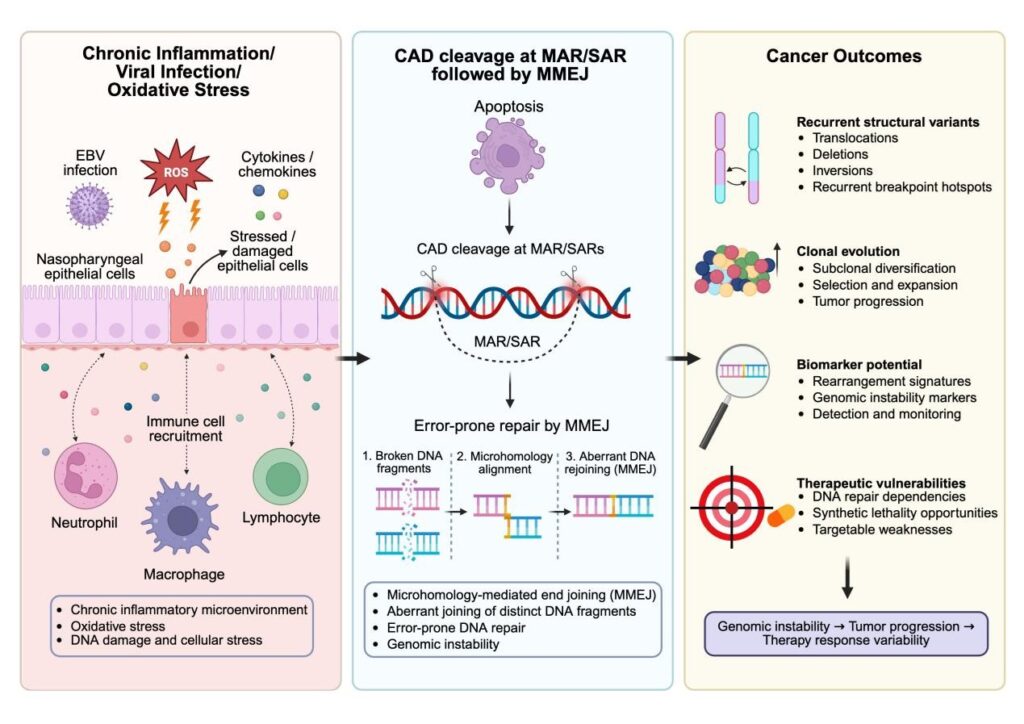
Figure 1. Conceptual overview of apoptosis-induced chromosomal rearrangements in cancer. Reproduced from Tan, SN. Oncogenesis 15, 41 (2026), Figure 1.
DOI: https://doi.org/10.1038/s41389-026-00645-x
Further Reading (Chinese)
To facilitate broader scientific communication, Dr. Tan also authored a Chinese-language feature article based on this review, which has been published by BioArtMED, a leading biomedical science communication platform in China.
Title (Chinese): Oncogenesis | 细胞凋亡如何塑造癌症基因组?陈珊妮综述癌症染色体重排形成的统一机制框架