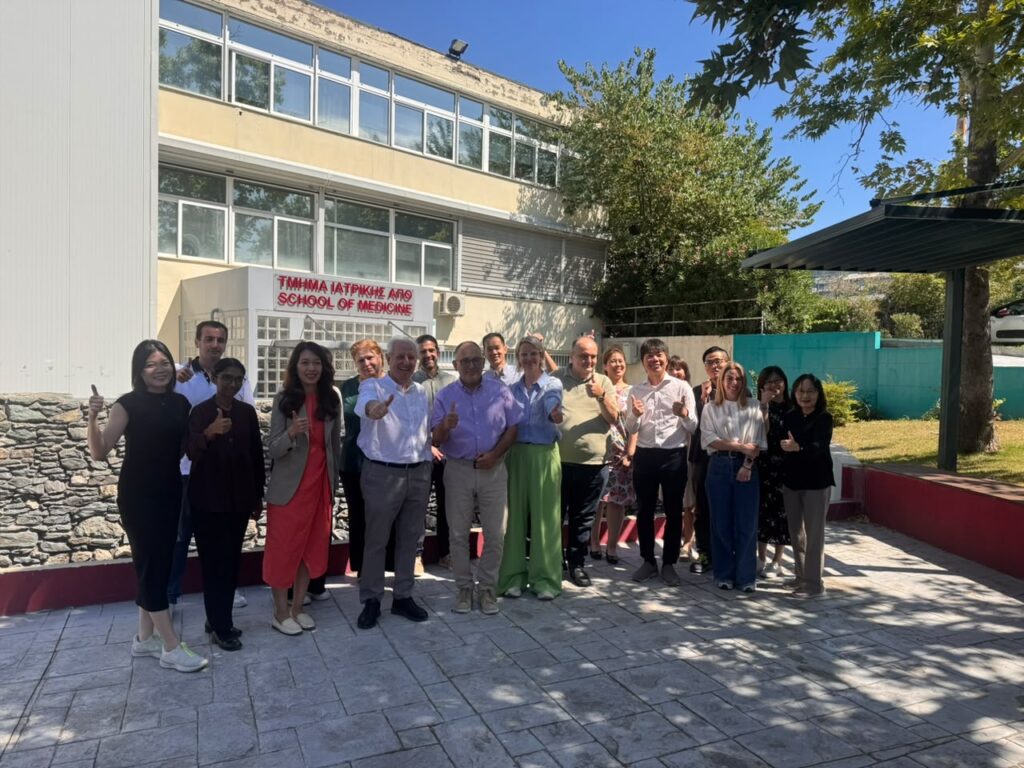
THESSALONIKI, GREECE – From July 10th to 14th, 2026, a delegation from Universiti Malaysia Sarawak (UNIMAS) successfully participated in the 2nd Project Management Meeting and the Train-the-Trainers Workshop for the UM-HEART-VR project. The events were hosted by the School of Medicine at the Aristotle University of Thessaloniki (AUTH), which is the largest public research university in Greece.
The UNIMAS delegation was led by Associate Professor Dr. Ooi Chor Yau from the Faculty of Medicine and Health Sciences (FMHS). The interdisciplinary team also included Professor Dr. Chew Keng Sheng (FMHS), Shalin Lee Wan Fei (FMHS), Associate Professor Ts Dr. Suriati Khartini Binti Jali from Institute for Tourism Research and Innovation (ITRI) and Dr. Mohamad Imran bin Bandan from the Faculty of Computer Science and Information Technology (FCSIT).
The UM-HEART-VR project, formally titled “Upskilling Malaysian Healthcare for Empathy and Communication through Virtual Reality,” is a capacity-building project in the field of Higher Education that is co-funded by the European Union’s Erasmus+ Programme. The recent gatherings in Greece successfully united European consortium partners — including Aristotle University of Thessaloniki (AUTH), European Union of Medical Specialists (UEMS), and Karolinska Institutet (KI) — with Malaysian partners Universiti Malaya (UM), Monash University, Malaysia (MUM) and Universiti Malaysia Sarawak (UNIMAS).
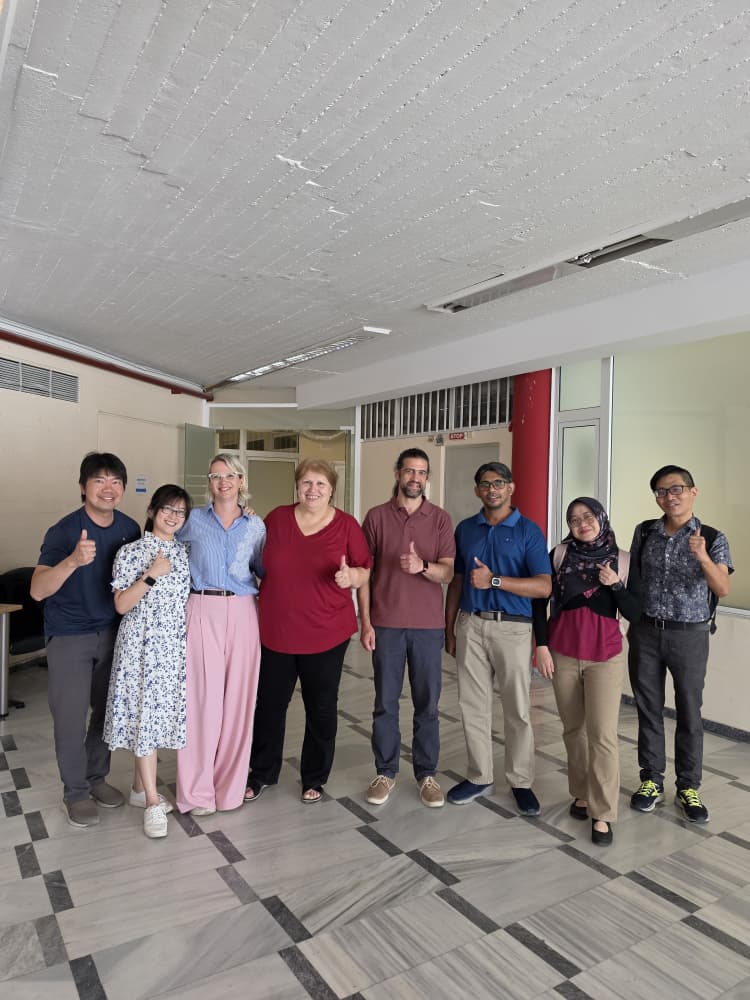
The 2nd Project Management Meeting aimed to synchronize the consortium’s efforts across multiple administrative and developmental Work Packages (WP). The meeting commenced with an opening address by Project Coordinator Professor Panagiotis Bamidis on the project’s goals, followed by reviews of VR-based training resource designs and their curricular integration. UNIMAS played a pivotal leadership role, spearheading both Work Package 3 by planning local faculty workshops and translating Train-the-Trainers materials, and Work Package 5 by strategizing the project’s digital dissemination and social media presence. Additionally, the agenda featured dedicated bilateral financial and managerial sessions between AUTH and partner institutions to coordinate procurement and preparatory activities.
Concurrently, the consortium held an intensive Train-the-Trainers Workshop. This specialized training was designed to empower educators and technical staff with the skills necessary to build and deploy immersive learning tools. The workshop integrated technical VR development with clinical pedagogy. Participants engaged in hands-on training focused on the ASPIRE co-creation process, gamification, software licensing, and 360-degree video production utilizing the 360 Labyrinth tool. To complement these technical skills, attendees explored pedagogical frameworks for teaching empathy and communication in patient-centered care, translating these theories into practical Digital Scenario-Based Learning (D-
SBL) lesson plans and tailored assessment rubrics. The sessions culminated with UEMS presentations detailing the European Accreditation Council for Continuing Medical Education (EACCME) approach to the evaluation and accreditation of these innovative educational episodes.
The successful conclusion of these meetings, which wrapped up with a tour of the Lab of Medical Physics and Digital Innovation, marks a significant milestone for the UM-HEART-VR project. The UNIMAS team is now equipped to bring cutting-edge virtual reality development and empathy-focused pedagogical strategies back to Sarawak, Malaysia, further elevating the standard of healthcare education in Borneo and the region.