Written by Gilbert Ganing Peter & Dr Leha Saliman
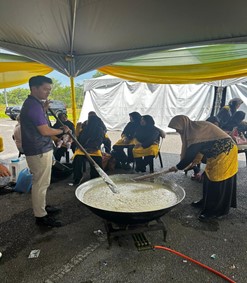
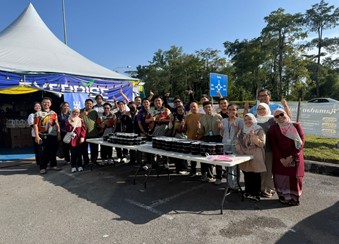
On 14 March 2026, Juma’ani Pavilion became a focal point for compassion and community engagement as volunteers comprising students, lecturers, and members of various organisations gathered for a Bubur Pedas Distribution and Iftar programme. The initiative was organised by CENTEXS Commercial Services Sdn. Bhd. in collaboration with the Politics and Government Studies (POLGOV) Programme Student Society under the Faculty of Social Sciences and Humanities, Universiti Malaysia Sarawak (UNIMAS). Held in conjunction with the holy month of Ramadan, the programme sought to strengthen community ties while fostering a spirit of volunteerism and civic responsibility among university students.
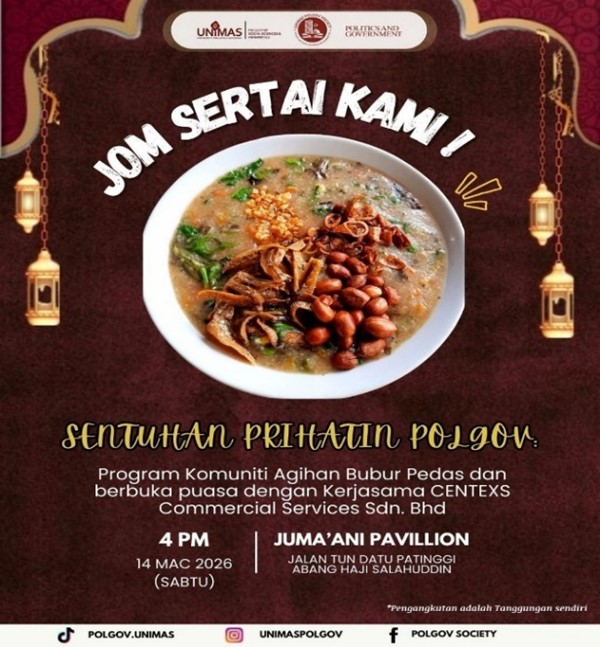
The programme centred on the preparation and distribution of bubur pedas, a traditional Sarawak dish widely enjoyed during Ramadan, followed by a communal iftar gathering. The activity brought together POLGOV students, academic staff, volunteers from various agencies, and members of the surrounding community in a collective effort to promote empathy, generosity, and social cohesion. Among the POLGOV lecturers who participated in the initiative were Dr Muhammad Azzubair Awwam Mustafa, Ms Najiha Zainudin, and Ms Athifah Bolhassan. Their involvement reflected the programme’s commitment to encouraging academic participation in community-based initiatives that extend learning beyond the classroom.
Through this initiative, students were provided with valuable opportunities to engage directly with the community while developing practical competencies in leadership, teamwork, and event management. Their involvement in the planning, preparation, and distribution processes enabled them to gain a deeper understanding of the importance of civic engagement and social responsibility. The communal iftar that followed further reinforced interaction and solidarity between university participants and members of the local community.
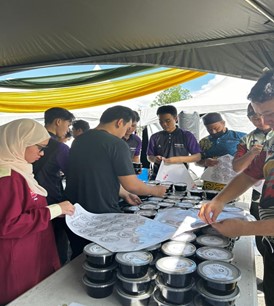
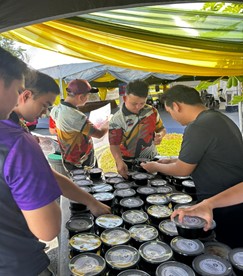
The outcomes of the initiative were significant. Students gained practical experience through their active involvement in cooking, food preparation, packing, and coordinating volunteer activities, while simultaneously developing organisational and teamwork skills. Their participation also fostered a deeper sense of civic responsibility and awareness of community needs. Community members expressed sincere appreciation for the programme, demonstrating how small acts of kindness can make a meaningful difference. Furthermore, the activity encouraged a culture of volunteerism among young people, inspiring them to remain actively engaged in social initiatives beyond the university environment.
POLGOV student volunteers also reflected on the significance of their participation in the programme. Asnol Khairulzakry Ainie described the experience as both meaningful and enlightening, noting that involvement in Sentuhan Prihatin demonstrated how simple acts of kindness can have a meaningful impact on the lives of others. According to him, the distribution of bubur pedas symbolised not merely the sharing of food but also the expression of care, empathy, and solidarity within the community. He further emphasised that the experience broadened his understanding of social realities and strengthened his sense of responsibility as a university student.
Similarly, Nur Farzzira Juraimie highlighted the importance of teamwork and empathy in fostering effective community engagement. She explained that working collaboratively with fellow volunteers and witnessing the gratitude expressed by community members made the experience particularly fulfilling. She added that the programme inspired her to continue seeking opportunities to contribute positively to society and to apply the knowledge gained through her academic studies in addressing real-world challenges.
Overall, the successful implementation of Sentuhan Prihatin POLGOV underscores the importance of collaborative initiatives involving students, educators, and external partners. Such programmes not only strengthen relationships between universities and the community but also highlight the vital role of higher education institutions in cultivating socially responsible graduates committed to public service and community engagement.
FSSH – A Partner for Social Change