Written by Rachel Jedrie
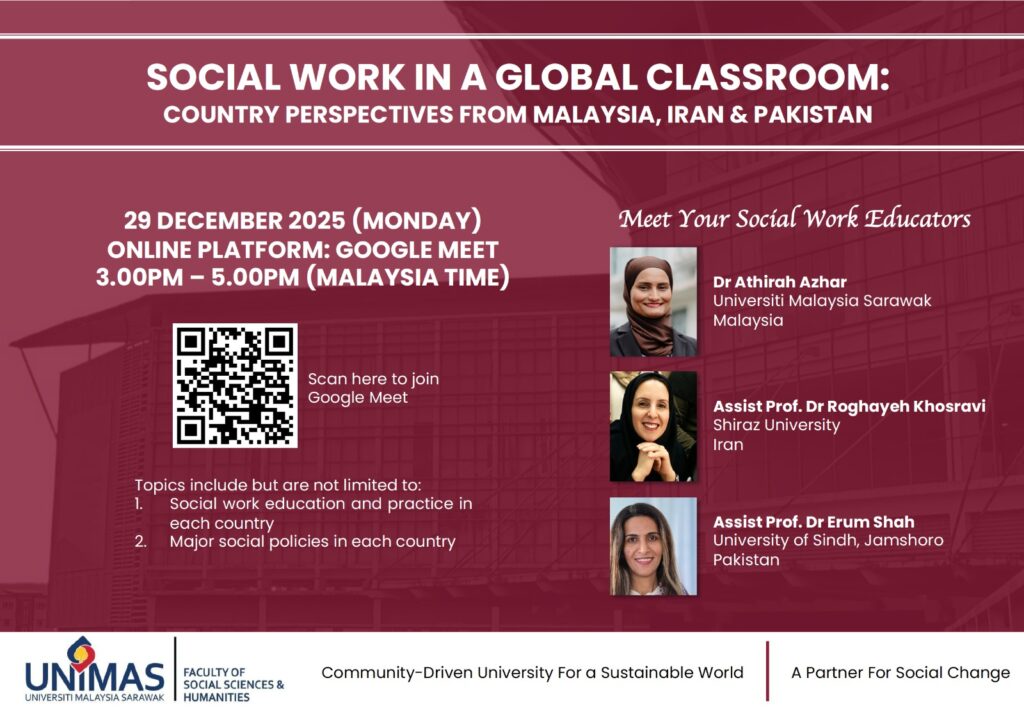
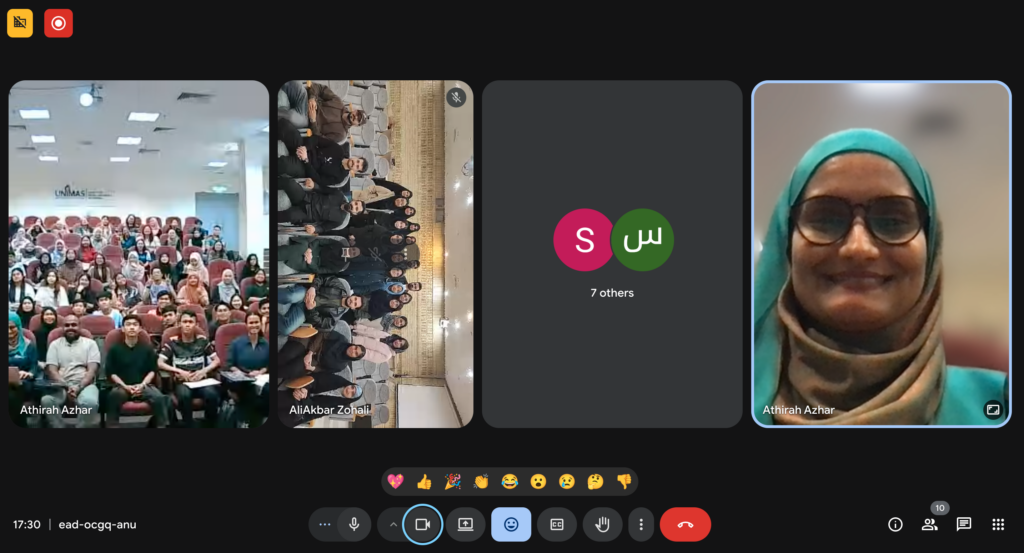
On Monday, December 29, 2025, the Faculty of Social Sciences and Humanities at Universiti Malaysia Sarawak (UNIMAS) convened a webinar titled Social Work in a Global Classroom: Country Perspectives from Malaysia, Iran & Pakistan. This session was part of the Learning Unit (LU) 10, Social Policy Across Borders, under the Social Policy Analysis and Planning (SSF3303) course. The online session conducted via Google Meet, featured a panel of social work educators including Dr Athirah Azhar from UNIMAS (Malaysia), Assistant Professor Dr Roghayeh Khosravi from Shiraz University (Iran), and Assistant Professor Dr Erum Shah from the University of Sindh, Jamshoro (Pakistan). The session was attended by 94 undergraduate students from UNIMAS, 23 undergraduate students from Shiraz University, and 4 students from the University of Sindh (2 postgraduate and 2 undergraduate). The event provided social work students with a critical comparative analysis of social policies and educational challenges across these distinct national contexts.
The session offered attendees a comprehensive understanding of how social work practice is influenced by local governance and infrastructure. A primary takeaway was the significant divergence in how nations address social inequality. While the core objectives of social welfare remain consistent, the mechanisms of delivery vary substantially, for instance, the Iranian context highlights resilience amidst economic sanctions, whereas the Malaysian context emphasizes the adaptation of Western pedagogical models to local cultural realities and Pakistan reveals a stark gap between legislative intent and grassroots implementation, often relying on religious philanthropy to fill voids left by the state.
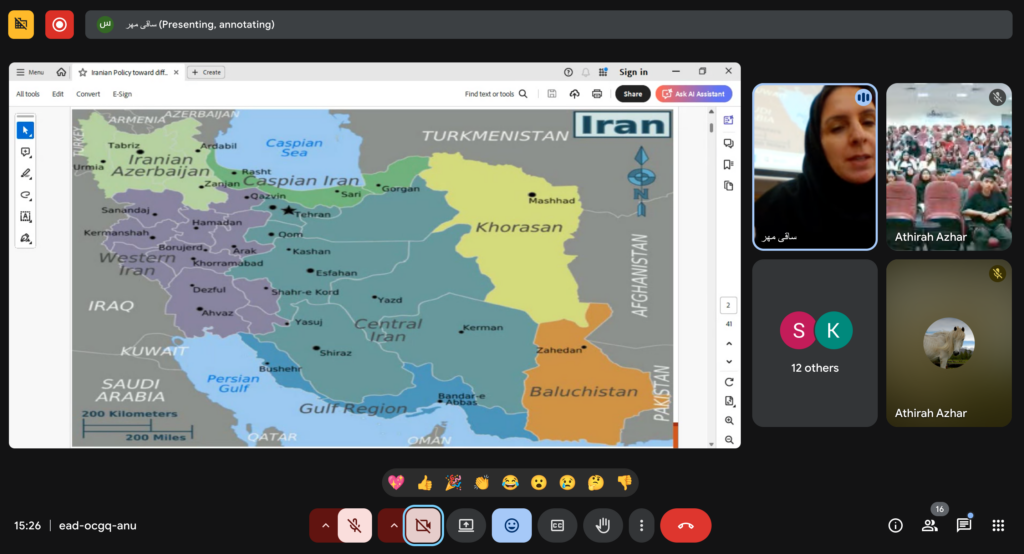
During the interactive dialogue on Iranian social policy, Sharvin a/l Sivaperuma one of the students from UNIMAS inquired how the nation supports vulnerable populations despite long-term challenges such as economic sanctions and social inequality. In response, Assist. Prof Dr Roghayeh Khosravi explained that the government has implemented significant awareness campaigns and security measures to maintain stability and ensure support structures remain functional despite external pressures. Subsequently, student from UNIMAS, Rachel Jedrie, raised a question regarding digital infrastructure, asking if Iran utilizes digital tools for subsidy distribution and whether internet restrictions impact tele-health. Dr Khosravi clarified that while Iran successfully utilizes a domestic network to efficiently transfer cash subsidies directly to citizens’ bank accounts, this same control makes online social work very difficult. She noted that doctors and social workers often rely on blocked international apps, while patients avoid domestic apps due to surveillance fears, creating a difficult environment for maintaining the privacy needed for effective care.
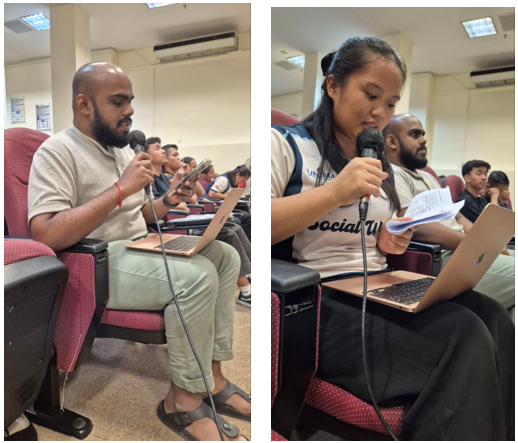
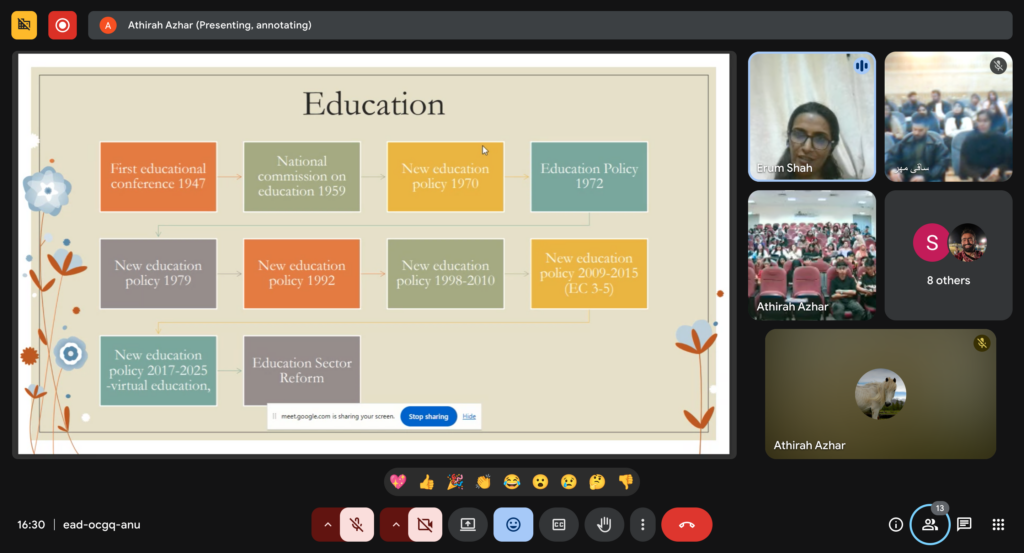
Turning to the Malaysian context, a student from Shiraz University asked the panel about the primary challenge in bridging the gap between social work theory and practice. Dr Athirah Azhar responded by acknowledging that the separation between theory and practice is a universal issue. She explained that the curriculum addresses this by placing students in agencies and community centres, for third-year students to apply their skills in the field. This structure allows students to engage in discussions and reflect on how to adapt these Western theoretical frameworks to the local Malaysian context effectively. The insights shared during this webinar underscore the complexity of modern social work practice, which must navigate not only human needs but also political, economic, and technological constraints. For emerging practitioners, particularly those in their final year of study, the session highlighted that professional competence extends beyond the mastery of theoretical frameworks. Sessions like this underscore the importance of a global classroom in modern social work education. By engaging with international experts, students move closer to becoming holistic practitioners who are not only aware of their own country’s policies but are also enriched by the wisdom and strategies of their global counterparts. As UNIMAS continues to position itself as a Partner for Social Change, such collaborations remain vital in shaping well-rounded, empathetic, and policy-literate future social workers.
FSSH – A Partner for Social Change