Written by Ahmad Nizar Yaakub
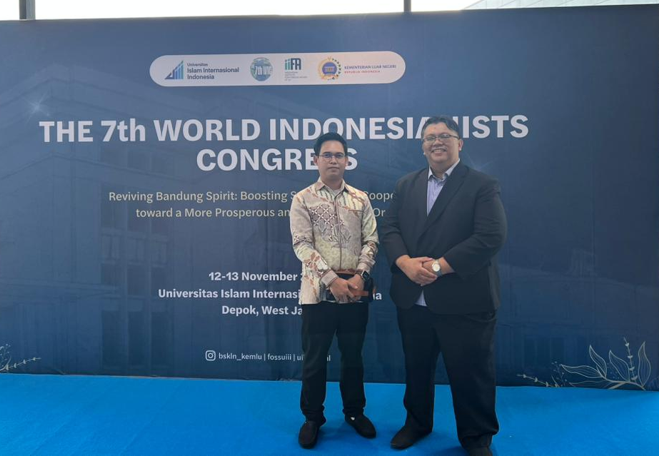
The 7th World Indonesianist Congress was held on 11-13 November 2025 at the Universitias Islam International Indonesia, Depok, Indonesia. Reviving the Bandung Spirit: Boosting South-South Cooperation towards a More Prosperous and Stable World Order was the theme for this year’s Congress. The Congress was jointly organized by the Indonesian Ministry of Foreign Affairs (KEMLU) and the Universitias Islam Internasional Indonesia. The Indonesian Ministry of Foreign Affairs through its Indonesian Consulate General in Kuching had funded Associate Professor Dr Ahmad Nizar Yaakub from the International Relations Programme, FSSH, UNIMAS to attend the Congress as participant and discussant. The Congress was attended by leading Indonesianists from universities, international organizations, media, Indonesian government officers and NGOs.
The Congress was officiated by the Vice Minister for Foreign Affairs of Indonesia, His Excellency Armanatha C. Nasir who pointed out the pertinent of the Congress to coincide with the 70th anniversary of the historic Asian-Africa Conference held in Bandung in 1955. Meanwhile, the keynote speech was given by Professor Ann Marie Murphy from Seton Hall University, USA on the topic ‘Indonesia’s Bridging Role: Promoting the Interests of the Global South in the Emerging International Order’. Prof Ann Marie spoke on the importance of upholding the Bandung Spirit and the Asian-African Conference’s Principle of 1955 through cooperation and collaboration in facing the current global challenges by the Developing Countries in Asia, Africa and Latin America. She also emphasized on the pertinent role and commitment played by Indonesia in the current conflict in Gaza and its membership in G20 and BRICS.
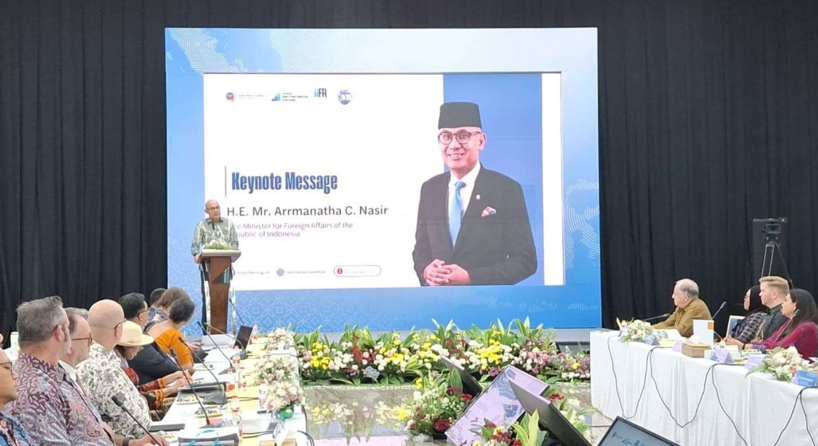
The Congress was later divided into three sessions: South-South Political Cooperation, South-South Economic Cooperation and South-South Cultural, Research and Education Cooperation. The sessions were divided in such a way to cover the wide array of topics that were relevant to Global South challenges. These were crucial to rejuvenating the Bandung Spirit and to attain a more prosperous and peaceful World Order.
Some of the critical issues discussed in the Congress were on Maritime Security and Ocean Governance by Prof Shankari Sundararaman from Jawharlal Nehru University; Economic Diversification and Trade Connectivity by Prof Ignacio Ortiz Vila from Universidad del CEMA, Argentina; Geopolitical Trajectory and Solidarity of Non-Aligned Countries by Prof Andrs Uhlin from Lund University, Sweden; and Food and Energy Security Partnership by Dr James Guild from Universitas Islam Internasional Indonesia. Most speakers shared the belief that in the midst of significant geopolitical and economic tensions between the great powers, the countries in the Global South should not lose sight of their own development agendas and shared interests.
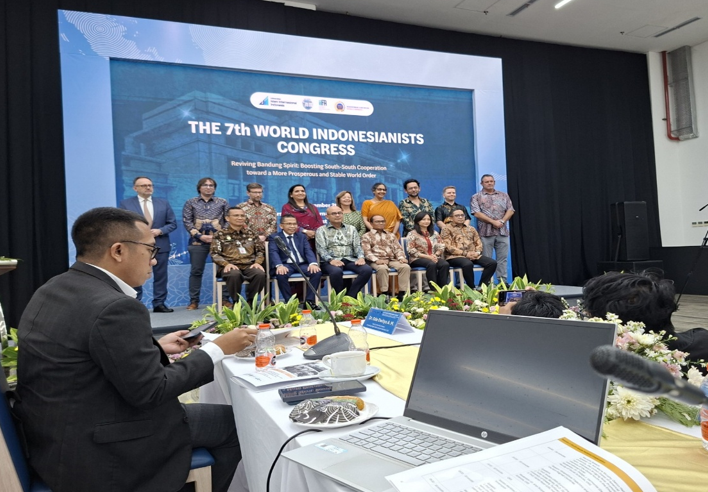
The Congress used a roundtable format with comments from discussants after individual’s presentation. These allowed for more intimate intellectual ambience among the speakers, while remaining open for the audience. These also allowed participants from academia, diplomats and civil society activists to ask questions or to give comments that benefit the speakers to improve their manuscripts.
Overall, the Congress is important as it gathered many Indonesianists all over the world to identify areas of potential cooperation in the Global South and tackling together challenges that stand of their way for mutual goals. It also acknowledged the role played by Indonesia in facilitating the Global South to achieve its shared goals. Moreover, the Congress participants fully agreed that the study on Indonesia should be given emphasis as it is the largest country in Southeast Asia in terms of area, population and economic size. It is also an important player in international organizations as the headquarters of ASEAN and the member of NAM, G20 and BRICS. In the same light, there should have been more expertise on Indonesia in Malaysian universities, and more studies and research done on Indonesia as Malaysia is the strategic and immediate neighbour of Indonesia and more so for Sarawak as it has a long international land border with Kalimantan. At the same time, there should also be a center of Indonesian Studies set up in many leading universities in Malaysia including UNIMAS.
After the Congress, a visit to the city of Bogor was organized to learn about urban cultural heritage by visiting the presidential palace, Kebun Raya (Botanical Garden) and the old town of Bogor. The Botanical Garden Bogor was considered as one of the oldest in Indonesia as it was established on 18 May 1817 and had the largest complex in the world (210 acres). Meanwhile, the city of Bogor bears the nickname ‘Rainy City’ as it receives frequent rain even during the dry season.
Instagram prepared by The Indonesian Consulate General Kuching on the overall visit can be seen through:
http://www.instagram.com/reel/DRMChQqkukn/?utm_source=ig_web_copy_link&igsh=MzRIODBiNWFIZA==
FSSH – A Partner For Social Change