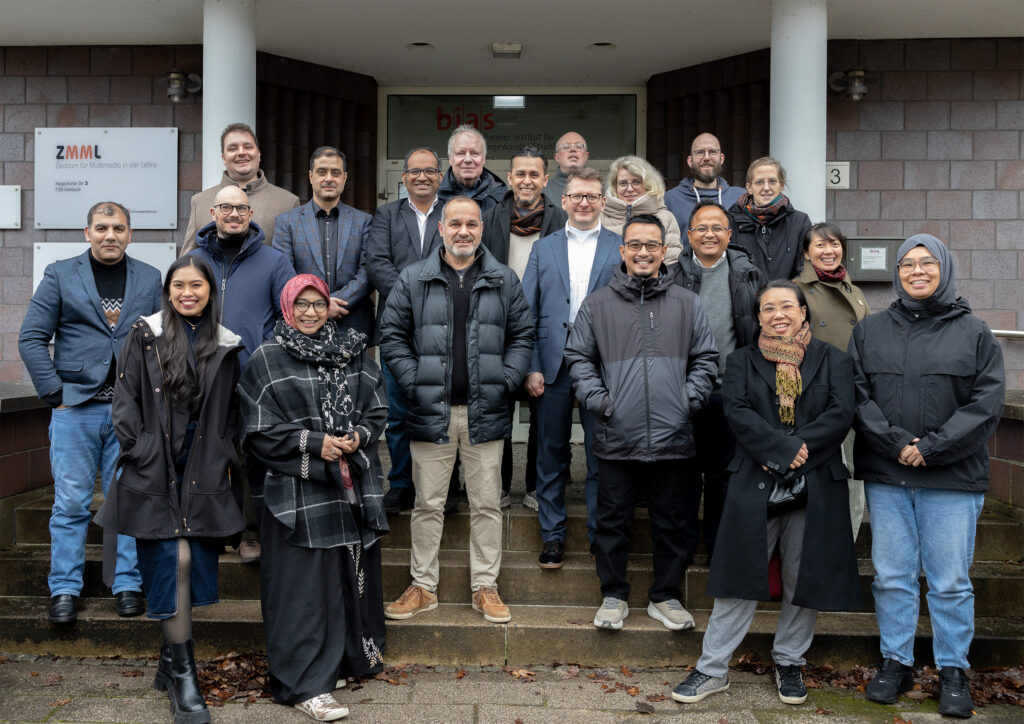
From bottom right: Dr. Haslina, AP Dr. Jacey, and AP Dr. Aazani represented UNIMAS at the Bremen Kick-off Meeting and Workshop for the ENTER Project in the University of Bremen, Germany, 11-13th February 2026.
By: AP Dr Aazani Mujahid
BREMEN, GERMANY – Representatives from UNIMAS partners recently took part in the Bremen Kick-off Meeting and Workshop for the newly awarded European Union ERASMUS project “ENTER: Environmental Open Data for Engaging Curricula and Research Training”. This marks an important step in the university’s continuing efforts to build meaningful international collaboration in sustainability, education, and community engagement.
Representing UNIMAS at the meeting were AP Dr. Jacey Lynn Minoi, Dr. Haslina Hashim, and AP Dr. Aazani Mujahid, who joined 27 other participants from ten other project partners among 6 countries (i.e., Germany, Estonia, Hungary, Italy, India, and Malaysia) to Bremen, Germany, from 11 to 13 February 2026. The activities were hosted by the Center for Multimedia in Higher Education (ZMML) at the University of Bremen.
The meeting brought together partners who shared an interest in making environmental education more open, relevant, and connected to real-world and localised needs. Among the main discussions were the development of micro-credentials, interdisciplinary electives, and more engaging approaches to research and learning (e.g., Living Labs, Summer Schools, Hackathons, and ECR Mentoring) that go beyond the classroom and connect more directly with communities and address current environmental challenges, especially in developing countries.
For UNIMAS, this was a valuable opportunity to contribute to the project’s early direction while also bringing in perspectives from Sarawak. The discussions in Bremen reflected many of the values which UNIMAS researchers continue to emphasise in our own work. It is pivotal that knowledge does not remain within institutions alone, and that universities play an important role in working alongside communities, partners, and stakeholders in ways that are practical, respectful, and impactful.
The ENTER project closely aligns with UNIMAS’ aspiration as a Community-Driven University for a Sustainable World. The UNIMAS team is mindful of creating space for universities to think more carefully about how teaching, research, and engagement can support sustainability in ways that are collaborative and meaningful, while remaining grounded in local realities. Building on previous successful projects, the UNIMAS team is multidisciplinary and has expertise from various Faculties and Institutes, namely
- Dr. Jongkar Grinang from the Institute of Biodiversity and Environmental Conservation (IBEC)
- Dr. Teng Sing Tung and AP Dr. Aazani Mujahid from the Faculty of Resource Science and Technology (FRST)
- Dr. Chuah Kee Man from the Faculty of Education, Language and Communication (FELC)
- AP Dr. Jacey Lynn Minoi from the Faculty of Computer Science & Information Technology (FCSIT)
- Dr. Haslina Hashim from the Faculty of Social Sciences and Humanities (FSSH)
Throughout the workshop, partners discussed project planning, work packages, ethics and quality assurance, stakeholder engagement, and future activities that will shape the next phases of the collaboration. There was also a useful exchange on the different ways institutions approach curriculum design, credit structures, and implementation, especially in an international partnership involving diverse systems and contexts.
The UNIMAS delegation shared insights relevant to biodiversity, environmental monitoring, sustainability, and community engagement – where local experience and local expertise matter. In a project such as ENTER, these place-based perspectives are important, not only for enriching the discussion but also for ensuring that respectful co-creation with stakeholders and future outputs remain relevant to the communities they are meant to serve.
Reflecting on the experience, Dr. Haslina shared that “the Bremen meeting opened our eyes to the valuable starting point for building shared ideas across partners, while also reminding us that sustainability work is strongest when it intersects and connects to people, places, and community realities.”
Beyond the formal sessions, the Bremen visit also helped strengthen relationships among project partners and laid a good foundation for future collaboration, including staff and student mobility. More than just a meeting, it was a chance to build trust and shared understanding – vital at the start to shaping projects that have the potential to bring real value to partner universities and communities.
As the ENTER Project moves forward, the UNIMAS ENTER team members look forward to contributing to work that supports more open, connected, and community-linked approaches to environmental learning and research. The Bremen meeting was a strong and encouraging start, reflecting UNIMAS’s ongoing commitment to global partnerships, sustainability, and community-driven impact.