Written by Dr. Sharifah Sabrina Syed Ali, FEB UNIMAS
KUCHING, 9 February 2026 – Politeknik Kuching Sarawak recently hosted an impactful Industry Enrichment Engagement Program (IEEP) titled “Islamic Accounting and Regulatory Framework”, featuring invited speaker Dr. Sharifah Sabrina Syed Ali from a public university, FEB-UNIMAS. The program formed part of a broader community outreach and inter-university collaboration initiative aimed at strengthening academic-industry linkages and enhancing students’ exposure to contemporary developments in Islamic accounting.
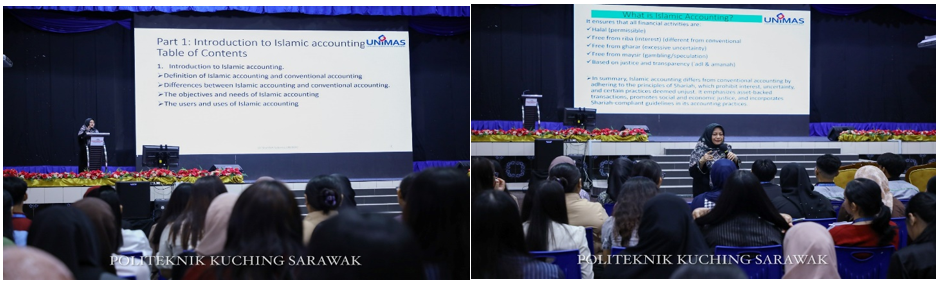
The session, attended by approximately 100 students and lecturers from Politeknik, underscored the growing importance of Islamic Accounting within Malaysia’s dynamic financial ecosystem. The talk was carefully structured to provide both foundational understanding and practical regulatory insights. Dr. Sharifah Sabrina began the lecture with an introduction to Islam as a comprehensive way of life, elaborating on the core beliefs (Aqidah) and the Five Pillars of Islam. She highlighted that Islamic accounting is not merely a technical discipline, but one deeply rooted in accountability (amanah), justice (adil), and transparency. In particular, she drew attention to the longest verse in the Qur’an, Surah Al-Baqarah (2:282), which addresses documentation of debt and financial transactions. A verse often regarded as a foundational reference for accountability and proper recording in Islamic accounting practices.
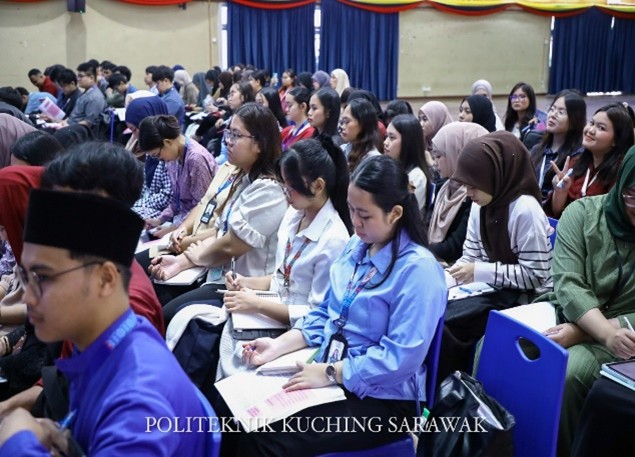
Moving into the academic core of the session, Dr. Sharifah explained the definition of Islamic accounting and contrasted it with conventional accounting. While conventional accounting focuses primarily on decision usefulness for shareholders and profit maximization, Islamic accounting extends accountability to Allah (SWT) and society, emphasizing Shariah compliance, social justice, and ethical responsibility. She elaborated on the objectives and needs of Islamic accounting, highlighting its role in ensuring fairness in financial reporting, promoting socio-economic welfare, and safeguarding stakeholders’ rights. The session also addressed the users and uses of Islamic accounting information, including investors, depositors, regulators, zakat authorities, and the broader Muslim community.
A substantial portion of the talk examined the regulatory and governance framework governing Islamic finance globally and locally. Dr. Sharifah discussed the roles of the Islamic Financial Services Board (IFSB) in setting prudential standards, the Accounting and Auditing Organization for Islamic Financial Institutions (AAOIFI) in issuing accounting, auditing, and Shariah standards, the International Accounting Standards Board (IASB) in developing international financial reporting standards, and the Malaysian Accounting Standards Board (MASB) in formulating national standards. She further emphasised the pivotal role of Bank Negara Malaysia (BNM) as the central regulatory authority overseeing Islamic financial institutions in Malaysia.
The session also explored accounting and reporting resolutions in line with the Shariah Resolutions issued by BNM. Key topics included methods of profit distribution, revenue recognition approaches in Islamic contracts, the application of the substance-over-form principle, probability principles in financial reporting, and the concept of the time value of money from a Shariah perspective. Dr. Sharifah clarified that while Islamic finance recognises economic realities, all applications must remain consistent with Shariah principles and avoid elements of riba (interest), gharar (uncertainty), haram products or services, and maysir (gambling).
The program was highly interactive. Throughout the lecture, Dr. Sharifah encouraged active student participation by posing reflective questions and inviting responses during the Q&A segments. At the end of the session, Politeknik lecturers conducted engaging quizzes to reinforce students’ understanding of the concepts covered, creating a lively, intellectually stimulating atmosphere.
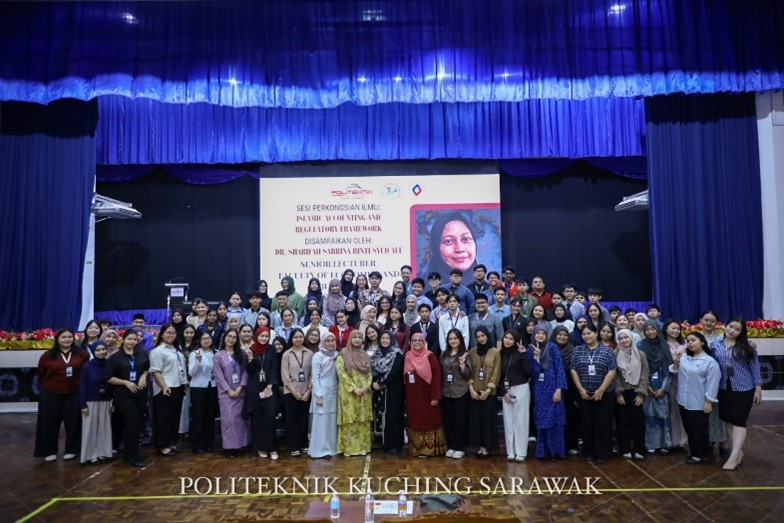
Indeed, the IEEP initiative reflects Politeknik Kuching Sarawak’s commitment to academic excellence and industry relevance, while strengthening collaboration among Malaysia’s public higher education institutions. The program not only enhanced students’ technical knowledge but also deepened their appreciation of ethical accountability within the Islamic financial system.
In her closing remarks, Dr. Sharifah Sabrina thanked the Politeknik staff and committee for inviting her and encouraged students to continuously seek knowledge, remain ethically grounded, and position themselves as future professionals who uphold integrity and Shariah-compliant practices in Malaysia’s evolving financial landscape.